Sign in to Loot Audio
Access your downloads, purchases and more
Access your downloads, purchases and more

Pulse is a revolutionary new downloader offering blazing fast speeds and powerful control over your libraries. Loot Audio uses Pulse to power some of our downloads and to make managing your libraries more efficient for you.
After your purchase we will send you a unique code (you will also find the code in your account). Use the code with Pulse to power your download and installation. More information about Pulse can be found here.
What are Credits?
You earn Credits every time you purchase a product from Loot Audio. 3% of your order is added to your account in the form of Credits.
Use Credits for money off future orders or convert them to Sample Credits to download samples from the Sounds section of the site.
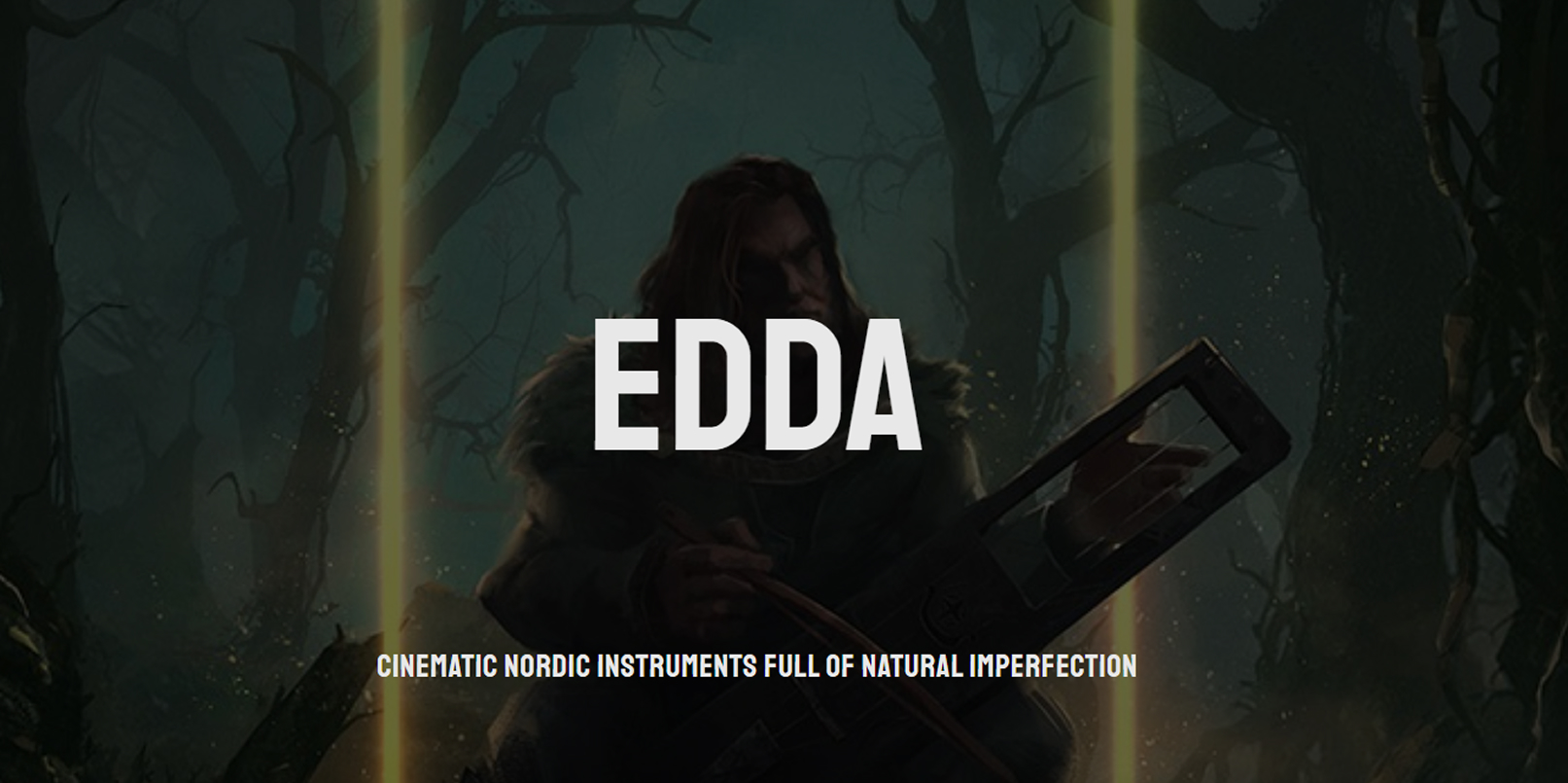
Cinematic nordic instruments full of natural imperfection
$139.00
Earn 375
Note: This product is compatible with Kontakt Player







In EDDA we used various complex sampling approaches to accurately capture all aspects of the tagelharpa like performance sampling and rebow and attack morphing techniques to achieve highly realistic performance and smooth legato transitions. Special attention was given to maintaining a natural dynamic balance between different bowing repetitions without over-compression, especially to blend the natural variations in bowing repetitions and dynamics.
Noise Reduction. Noise reduction is minimal for sustain and attack samples. Noise reduction is moderate for release samples. Of course, clicks, pops, and rare breath sounds have been completely removed. But musical noise and small artifacts are left untouched. These small artifacts are a direct result of the performance sampling approach and subjectively sound more natural. But we understand that it’s important to keep the balance and make sure they’re not repetitive and too noisy.
Stretching and pitching. Aggressive stretching and pitching can be (!!) very destructive to the tagelharpa. Keep this in mind when aggressively editing the instrument. When using phrases, try to find and use the phrases that are closest to the original bpm. If the phrases are beat machine based, then the phrases are not stretched and this point is not important. Remember that you can always double the speed up or down. So, x2 75 equals 150.
Sampling strings in groups. After much experimentation, we have found that sampling the strings in groups rather than individually produces the most natural and authentic sound. Due to the inherent tuning instability and subtle tuning fluctuations of the tagelharpa, recording the strings individually would have required extensive phase alignment and autotuning, resulting in audio artifacts and huge phase issues. But (!!) on the second, large tagelharpa, we were able to sample the burdons and melodic strings separately without any phase issues. This allows you to control, bypass or adjust the tuning of the burdon strings.
4s Tuning. The tagelharpa by it’s nature is limited in tuning, and the range and number of possible tunings is limited. In the standard DAD tuning it is of course possible to play in other tunings, but it’s most comfortable to play in D minor and D major (quint-quart). If your song is in, let’s say, C major, you can still play in D tuning (it works well in most keys) or pitch down the instrument and make it CGC (two semitone tuning sounds very good in most cases). This makes the Tagelharpa perfectly tuned for C minor and C major. Do not forget that in EDDA there is not only the quint-quart tuning. You can tune the tagelharpa in DGD and the sound will be more traditional.
The main instruments in EDDA are fully playable without the use of pre-recorded phrases, which gives a wide range of performance possibilities. We sampled every note and every possible transition, even dissonant note combinations, almost any melody and harmony can be played.
Sequencer.
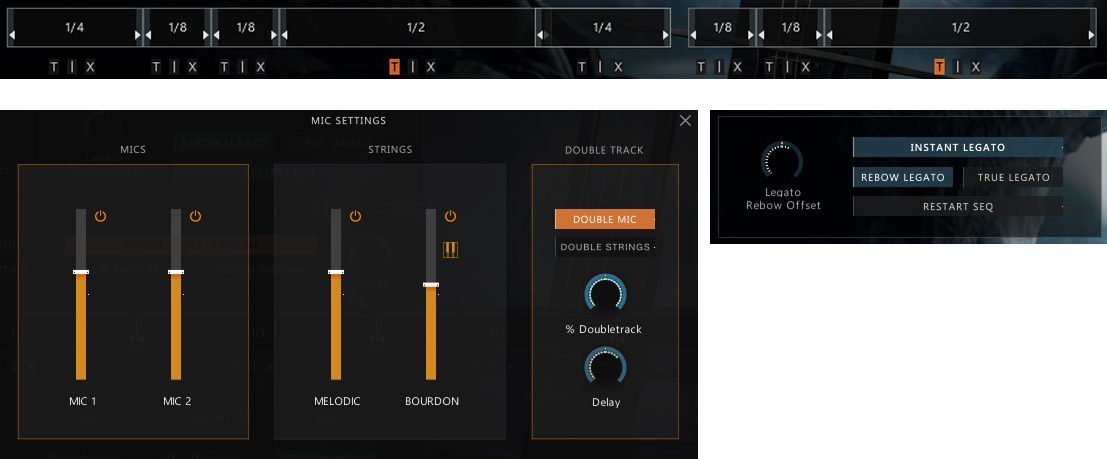
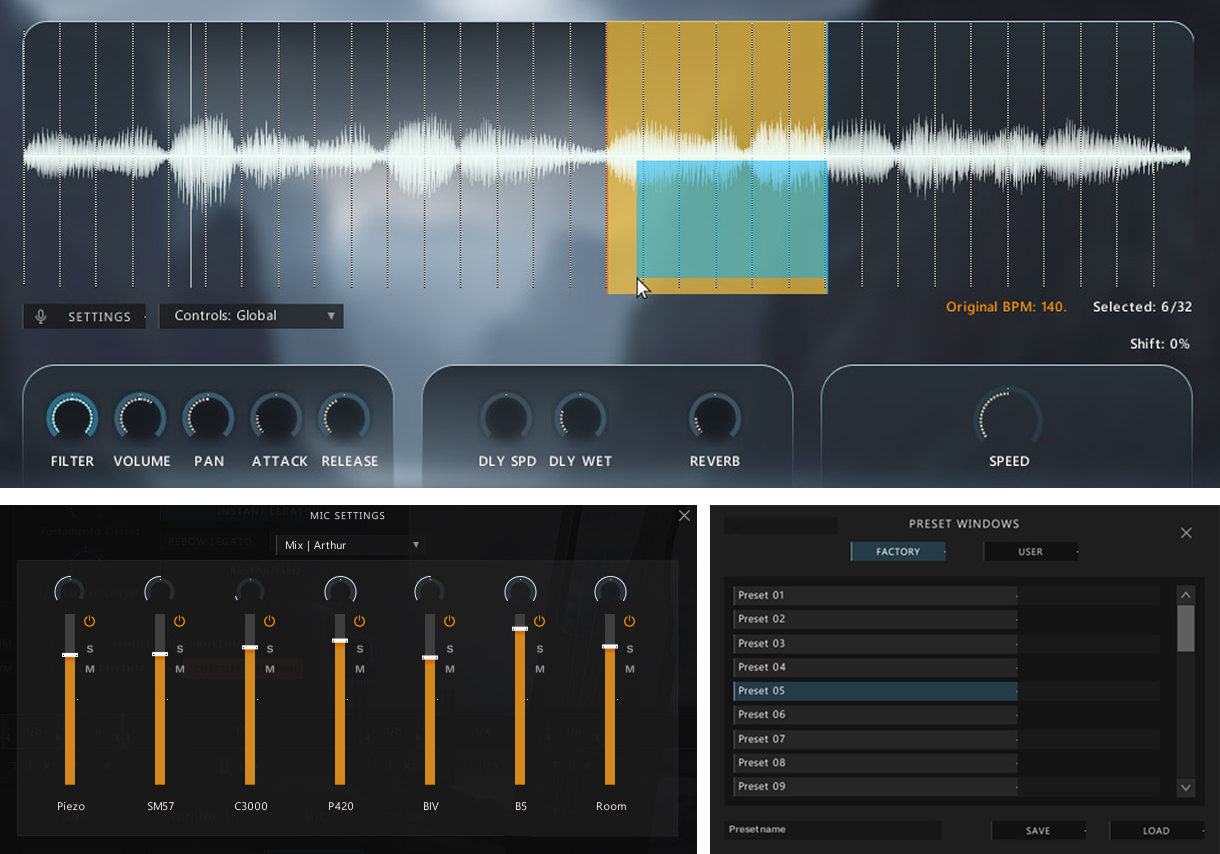
We built a brand new sequencer with advanced features and MIDI drag-and-drop functionality to DAW or computer. Sequencer has a 5 patterns. Users can load and edit preset sequences, or create their own from scratch and save it.
Mic settings.
Edda offers flexible microphone settings to sculpt and shape the sound. With a range of presets and individual controls for each microphone’s volume, panorama, and stereo image, the sound can be balanced to fits any mix.
Burdons & Doubletrack.
The Big Tagelharpa has two microphones, with separate controls for the melodic and burdon strings. The burdon strings can also be pitched down, making it a powerful tool for sound design. Doubletrack can be applied to either the microphones or the strings.
Legato.
EDDA offers several types of legato: Rebow Legato, Portamento, Fast, and Trill. Instant Legato ensures that legato is triggered immediately on note changes, without waiting for the next rhythmic step. Restart Seq immediately resets the sequence on a note change and starts the sequence from the beginning. If both Instant Legato and Restart Seq are turned off, the engine will allow the current step to finish before switching to legato.
Phrases.
We have included many ready-to-use phrases to speed up the workflow. They are all sorted by tagelharpa type and bpm.
Presets.
Preset window with Factory and User presets.
1. Scoring Tagelharpa - Stability and predictability with a deeper level of detail, smoother compared to Big Tagelharpa.
This library is licensed for use in the free Kontakt Player. It can be used in Kontakt Player or the full retail version of Kontakt. It requires online registration through the Native Instruments Native Access system. This library is also fully compatible with Komplete Kontrol and all NKS Standard hardware and software by Native Instruments.