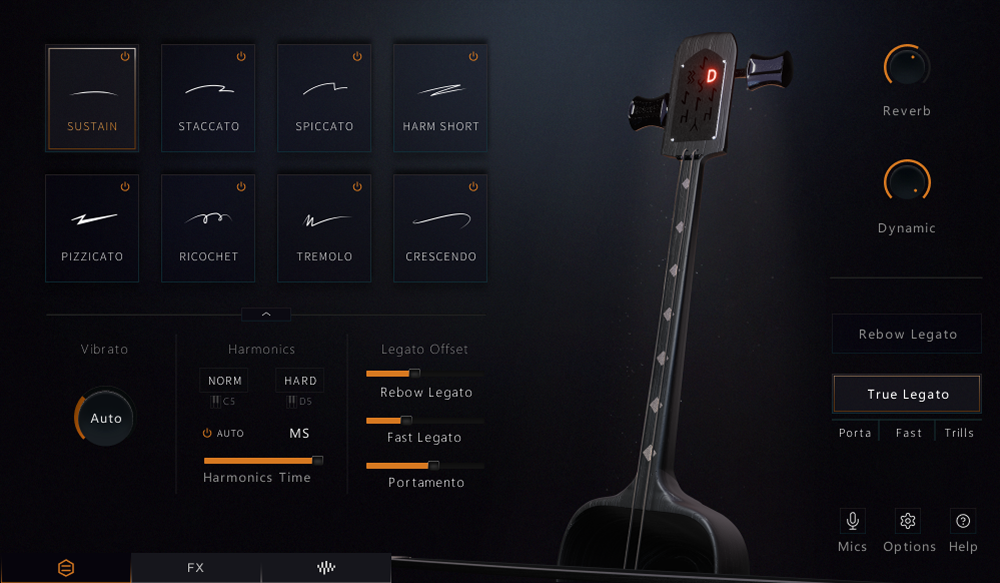
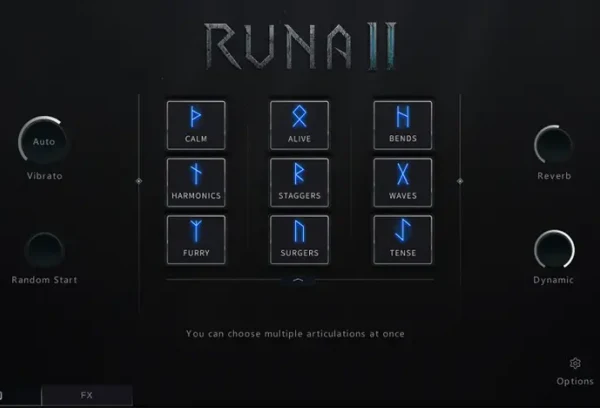
In Runa: Elder Scoring Strings, we used our favorite sampling techniques, such as performance sampling, rebow & attack morphing, to achieve highly realistic performances. We applied all our experience with products such as Ashen Scoring Cello and Edda to the specifics of the new instrument. We paid special attention to maintaining a natural dynamic balance between different bowing repetitions without over-compression. We did a lot of experimentation with the performance sampling of legato transitions. We also tried many variations of backing tracks to find the perfect balance between the correct bowing speed for various BPM and dynamic control.
Phase-alignment. Keep in mind that we pay special attention to the phase alignment of the samples to avoid artifacts in dynamic and legato crossfades. However, panning the mics and adding delay (to achieve an additional stereo effect) could lead to phase effects, such as volume changes, “phaser,” and “chorus.” If you want to use delay, we recommend using the default settings (-25 ms). We did hundreds of hours (thanks to the patience of the editors) for tests and volume rebalancing to ensure that the instrument does not have phasing issues and is balanced for 0 ms and -25 ms delay settings. However, you can experiment with other settings to achieve a different stereo effect.
Noise Reduction is minimal for sustains, tremolos, and attack samples. Noise reduction is moderate for shorts and crescendo samples. Noise reduction is strong for release samples. Musical noises and small artifacts are left untouched. These small artifacts are a direct result of the performance sampling approach and subjectively sound more natural. But we understand that it’s important to keep the balance and make sure they’re not repetitive and too noisy.
Limited range. Some may find the instrument’s range quite limited. This is because the original kobyz only has two strings. We plan to sample the Nar-Kobyz, which covers a lower range of notes. Additionally, you can tune the instrument’s mic settings to match the desired range. The instrument is fairly tolerant of non-extreme pitching.