Sign in to Loot Audio
Access your downloads, purchases and more
Access your downloads, purchases and more

Pulse is a revolutionary new downloader offering blazing fast speeds and powerful control over your libraries. Loot Audio uses Pulse to power some of our downloads and to make managing your libraries more efficient for you.
After your purchase we will send you a unique code (you will also find the code in your account). Use the code with Pulse to power your download and installation. More information about Pulse can be found here.
What are Credits?
You earn Credits every time you purchase a product from Loot Audio. 3% of your order is added to your account in the form of Credits.
Use Credits for money off future orders or convert them to Sample Credits to download samples from the Sounds section of the site.
Revive the multitimbral experience and sonic capabilities of the original hardware synths.
$69.00
Earn 183







Based on the 1981 Mk I and 1982 Mk II versions of the Trident analog polyphonic multitimbral synthesizer
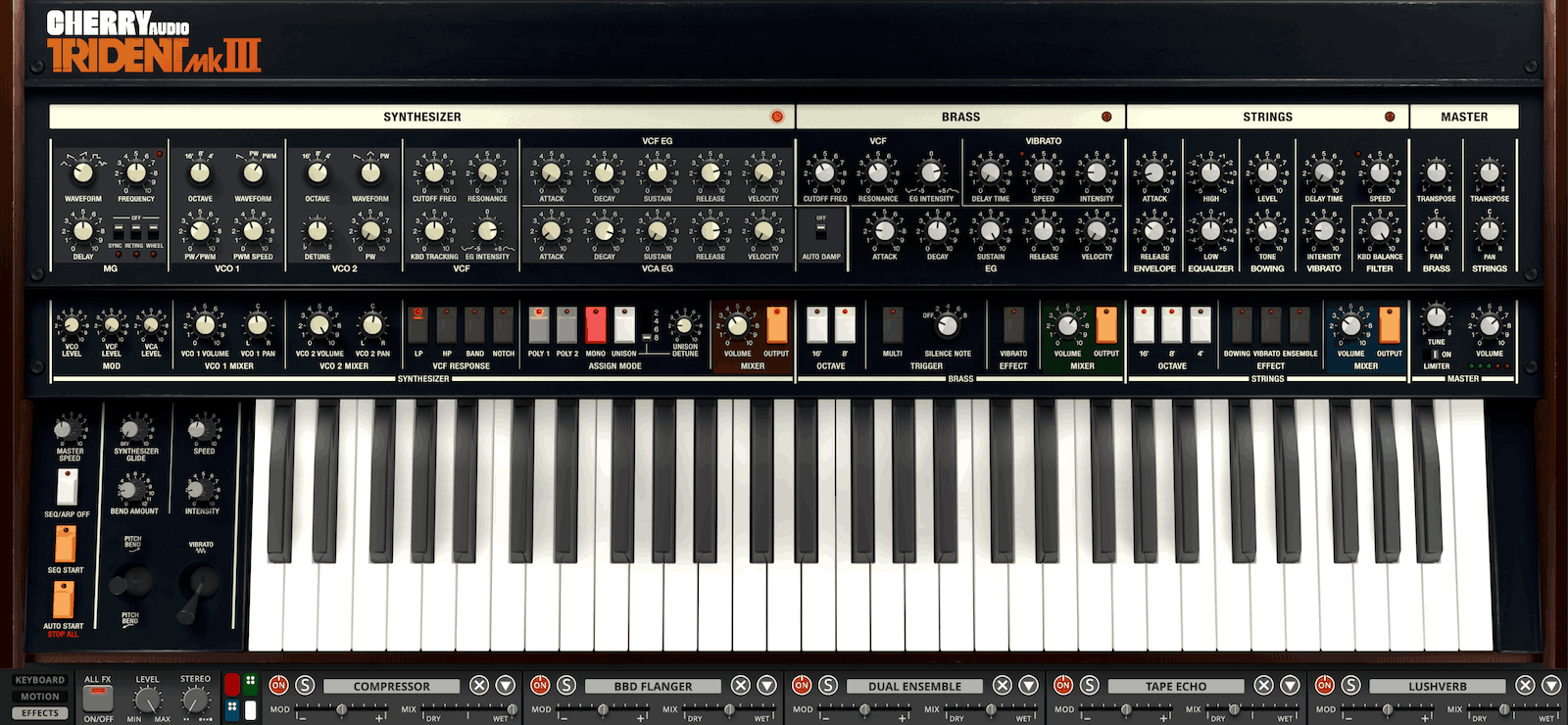
All three sections -- Synthesizer, Brass, and Strings -- superbly recreated and significantly enhanced with expanded functionality and modulation options
Up to 16 voices for each section
Polyphonic Synthesizer section with dedicated mixer
Paraphonic Brass and String sections with dedicated mixers
Support for velocity and aftertouch (including polyphonic aftertouch with compatible controllers) and pedal expression, independently assignable to the sections to control volume, filter, and modulation
Synthesizer Section
Voice Modes: Monophonic, two Polyphonic modes, or 2, 4, 6, or 8 Unison
Two VCOs: one with sawtooth, pulse width, and PWM waveforms; the other with sawtooth, triangle, and pulse width
VCF per voice with LP, HP, Band, or Notch response and keyboard tracking, based on the original's SSM 2044
Two envelope generators (EG)
Syncable dedicated Modulation Generator (LFO) with triangle, sawtooth, ramp, square, and sample & hold waveforms, with delay and retrigger
Brass Section
Dedicated filter with cutoff, resonance, EG intensity, auto damp
Dedicated vibrato with delay and EG
Silence note and multi-trigger options
String Section
Dedicated filter with attack/release envelope
Equalizer
Bowing control
Vibrato with delay
Master Mixer with stereo panning, transpose, and master tune
Pitch bend and vibrato joystick controls, with glide for the synthesizer section
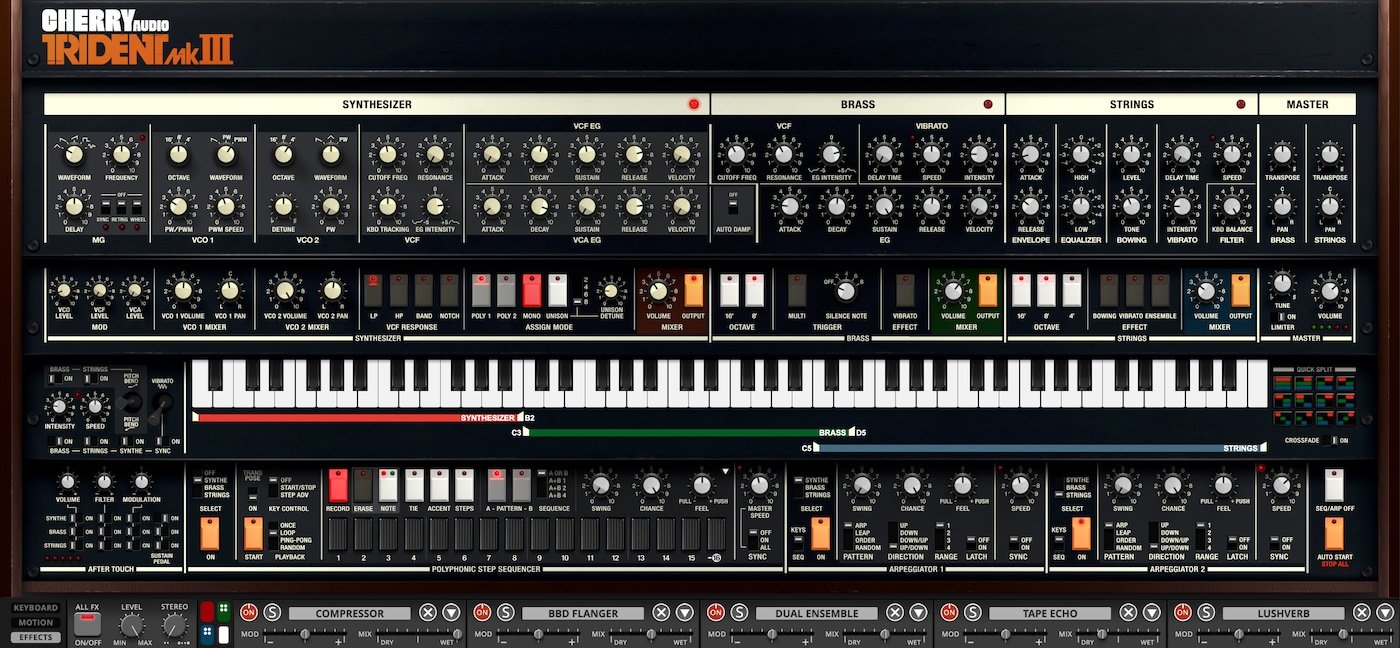
Hideable switching lower panels for Keyboard, Motion (a new feature), and Effects
Independent key range assignment for all three instrument sections for layering and splitting, with crossfade, assignable through draggable zone handles or "Quick Split" templates
Motion Controls
16x2 polyphonic step sequencer with start, stop, and auto start options, with accurate DAW clock and step synchronization
Patterns can be programmed to record real-time notes or as steps, with ties, accents, and Pattern A and Pattern B variations and combinations
Two assignable dynamic arpeggiators with four modes – Arp, Leap, Order, and Random
Swing, Chance, and Feel groove controls for both the sequencer and arpeggiators to add degrees of randomness to arpeggiated patterns
Integrated Effects
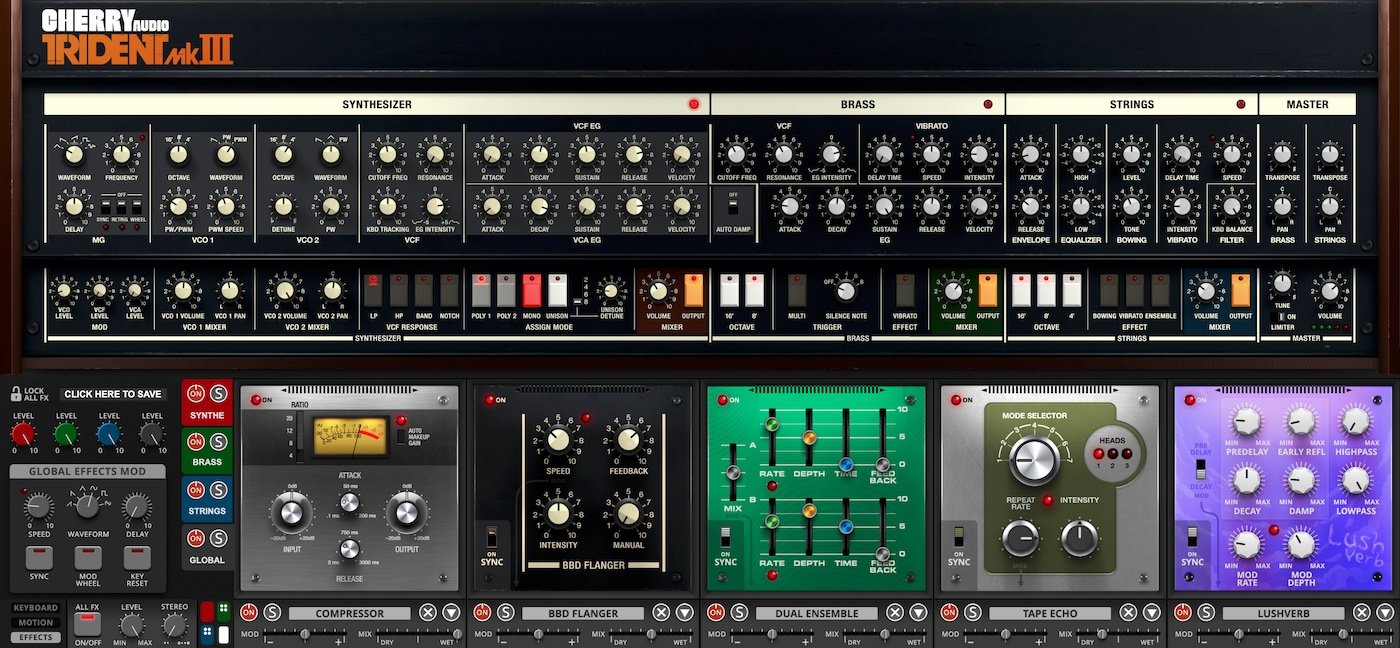
Four independent customizable chains of effects, one for each instrument section plus global, with a global effect modulator
17 studio-quality effects that can now be arranged, saved, and recalled within its four effects chains:
BBD Flanger (new, based on the Trident original)
Compressor
Digital Delay
Digital Reverb
Distortion & EQ
Dual Delay (new)
Dual Ensemble (new)
Dual Phaser
Envelope Filter
Flanger & Chorus
Galactic Reverb
Lo-Fi (updated)
Lushverb (new)
Ring Modulator (new)
Seven Band EQ
Spring Reverb (new)
Tape Echo (new)
Persistent mini UI Effects controls for on/off, solo, bipolar modulator amount slider, and dry/wet mix for each effect. Global FX on/off, level, and stereo expand.
Over 380 professionally designed presets in 14 categories, accessible in a convenient preset browser
Standalone virtual instrument and plug-in versions included
User-adjustable oversampling control
Complete MIDI control and DAW automation for all controls, with easy-to-use MIDI learn and mapping (Preset and Global)
Cherry Audio's popular Focus zoom-in feature, as well as standard UI zoom and resize via drag
Complete documentation available directly online from the instrument or in downloadable PDF format
The lower panels for Keyboard, Motion (a new feature), and Effects have been significantly expanded to include a virtual studio of tools that enhance this "orchestra-in-a-box" experience like never before. These features include drag-and-drop zones and quick templates for splits and layers, a DAW-friendly 16x2 polyphonic step sequencer, and dual arpeggiators. Trident also features 17 studio-quality effects that can now be arranged and reused within its four effects chains. These effects include the original BBD flanger, a compressor, a lo-fi effect, a phaser, a ring modulator, a 7-band EQ, and various delays and reverbs, including the new Lushverb.
With comprehensive MIDI mapping capabilities and over 380 professionally designed presets, Trident is a must-have virtual instrument that will captivate both vintage synth enthusiasts and contemporary music producers.
In 1981, Korg introduced a remarkable synthesizer called the Trident to the music world. This versatile, multi-timbral, multi-section analog polyphonic synthesizer included three outstanding instruments: a robust polyphonic synthesizer, a smooth string machine, and a powerful brass section. This combination made it a comprehensive tool for creating symphonic sounds. In 1982, Korg released an enhanced "Mk II" version of the Trident. Over the years, it has been prominently featured in the music of various artists, including Paul Humphreys from OMD and Rick Wakeman of YES. Additionally, musicians such as Boards of Canada, Tycho, Phoenix, and Pulp have also used the Trident in their work.
Despite its innovative features, the Trident never reached the same level of popularity as the Prophet-5 or the Jupiter-8. The Trident faced several challenges, including its high price, complex design, and unfortunate timing. When Yamaha's DX7 introduced affordable digital synthesis, it overshadowed the Trident's warm analog sound. As the music scene shifted toward digital instruments like the Korg M1 and Roland D-50, the Trident faded from prominence.
Four decades later, Cherry Audio has resurrected this overlooked gem with the same warmth, depth, and swagger as the original, minus the back-breaking weight, maintenance nightmares, and $4,500 price tag (80s dollars!). Additionally, Trident Mk III enhances the experience with extra features and sound options, making it the ultimate version of the classic synth.
Each section now features 16 voices. The Synthesizer section is fully polyphonic, with a filter for each voice, allowing for independent shaping. The Brass and Strings sections remain paraphonic, like the hardware, each having its own filter to shape their ensemble character.
Cherry Audio's Trident again showcases a thoughtful design and beautifully rendered user interface. It features persistent sound design controls at the top for easy access. The separate lower panel modes reveal additional functionalities, and we have further enhanced these features.
The Keyboard panel includes hideable keys and provides quick access to performance tools. These features enable you to add real-time expressive flourishes that bring a performance to life with techniques such as bending, sliding, and vibrato. In addition to supporting velocity, Cherry Audio's Trident Mk III also offers both channel and polyphonic aftertouch, enabling expressive performances in ways that were not possible with the original hardware.
The all-new Motion panel allows users to easily assign key splits and layers using both one-click Quick Split templates and draggable zone controls. It also features discreet vibrato controls for each section, aftertouch assignment, a transposable 32-step polyphonic sequencer, and two advanced arpeggiators that can be customized. These features enable users to set up and play the Synth, Brass, and String sections simultaneously in various ways, bringing this multitimbral orchestra-in-a-box to life at their fingertips.
The original Trident hardware featured a single BBD flanger and a built-in ensemble effect for Strings. In contrast, Cherry Audio's Trident offers an enhanced set of Effects panels with 17 different effects. You can arrange chains of up to five effects in each section: Synthesizer, Brass, and Strings. Additionally, there is a Global effects chain that processes all three sections together.
Each effect pedal can be adjusted, bypassed, reordered by dragging, copied, soloed, and duplicated. You can also save and recall chains for use in other presets. Furthermore, a dedicated LFO Effect Modulator allows you to modulate entire chains. The Effects panels can be minimized, providing essential control access at the bottom for immediate use.
Cherry Audio has designed Trident to appeal to both new and experienced synth enthusiasts. Beginners will enjoy the instant gratification provided by over 380 presets, many of which come with preconfigured sequencer and arpeggio patterns across multiple layers. More advanced users will discover a range of evolving timbres that extend far beyond what the original hardware could offer.
Cherry Audio has teamed up with Tim Shoebridge and Mike Martin to produce an extensive introductory video for Trident Mk III. This deep dive highlights its standout features, including its three parts, layers and splits, the sequencer, the arpeggiators, and the new customizable effects chains.
Trident Mk III Synthesizer by Cherry Audio is available in AU, VST, VST3, AAX, and standalone formats.
macOS Requirements: macOS Requirements: macOS 10.13 or above. 64-bit required. Intel or Apple Silicon processor. 3.4 GHz Quad-Core or Apple Silicon CPU with 8GB of RAM is recommended. Hard disk space: 110 MB.
Windows Requirements: Windows 7 or above (including Windows 11), 64-bit required. 3.4 GHz Quad-Core computer with 8GB of RAM recommended. Hard disk space: 110 MB.
NOTE: Internet connection required for product activation