Three rooms, each with its own voice. Pick one by ear.
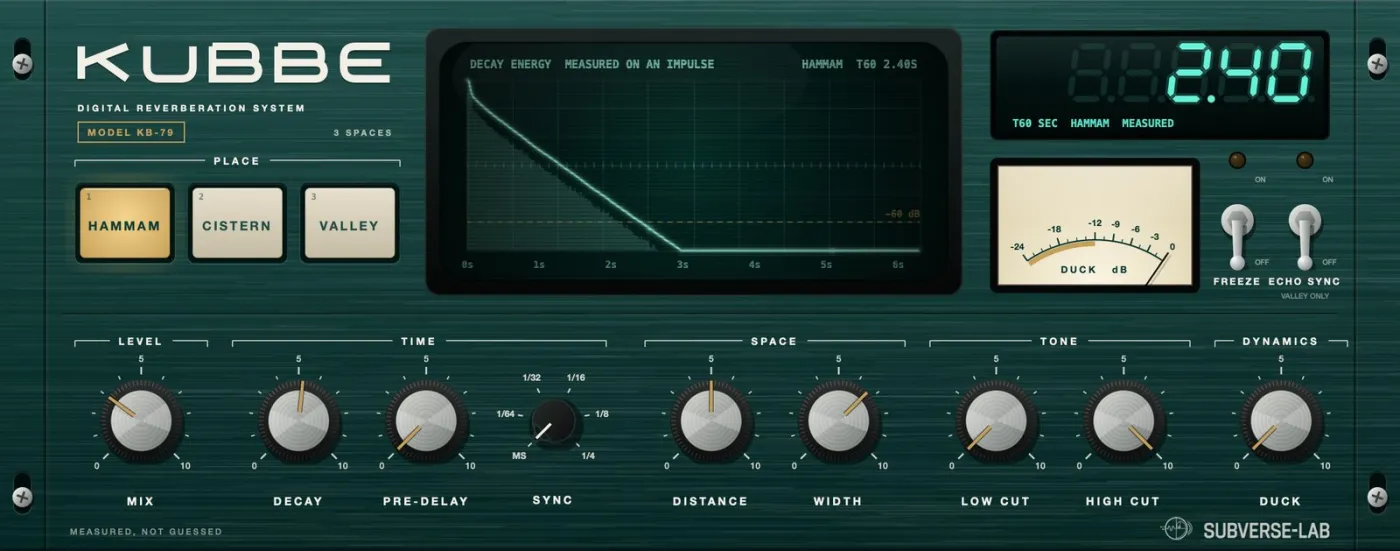
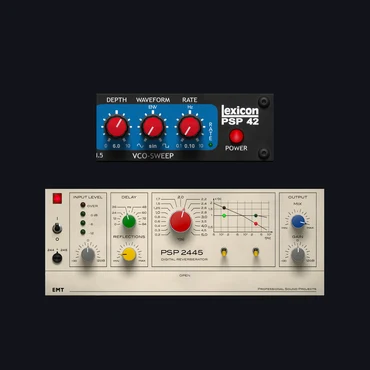
Most reverbs hand you a list of algorithms and leave you scrolling. KUBBE gives you three distinct architectural spaces, and you hear the difference the moment you switch: a bright marble dome, a long dark cistern, and an open valley whose echoes can land directly on your beat grid. Wearing the face of a 1979 rack unit as it looked the day it left the factory, every tail is generated 100% algorithmically by the engine itself—no impulse responses, nothing static.
Three Distinct Modes
- Hammam: Short and bright. Dense first reflections, a natural flutter between parallel marble walls, and a musical ring in the low mids (~2.4 s measured T60).
- Cistern: Long and dark. Underground column slaps arrive late and sparse with a slow-moving, water-like tail (~6.6 s measured T60).
- Valley: Open and rhythmic. Discrete echoes answer one by one from far slopes, each darker and more blurred. With Echo Sync enabled, echoes lock to 3/4, 5/4, 7/4, 5/2, or 7/2 beats.
Measured Decay & Mix-Ready Controls
- Measured Schroeder & T60 Display: Runs the engine on an impulse whenever settings change, drawing energy per 20 ms and the Schroeder curve while printing the true measured T60 in seconds.
- Seamless Mode Switching: Switching rooms lets the previous tail ring out naturally over 1.5 seconds instead of cutting it dead.
- Built-In Ducking & Freeze: Duck steps the reverb tail back by up to 24 dB while the dry source plays, and Freeze holds the tail ~6 dB under its level while you play over it.
- Complete Shaping: Pre-Delay (0–250 ms or tempo-synced 1/64 to 1/4), Distance (near early reflections to far darkened room), Wet-only Low Cut & High Cut, and Width (Mono to 150%).
Documentation: KUBBE User Manual (PDF)