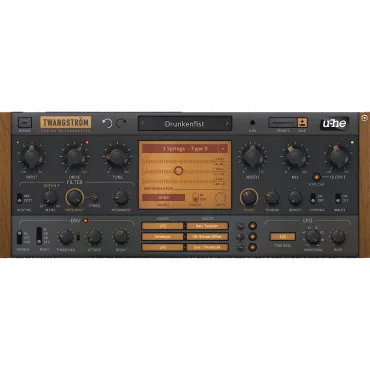
Hitting your computer won’t make Twangström shatter, so we added a twang control. This is used to shake the springs, either manually or through modulation and automation. You might think this is a gimmick for which you have no further use (apart from waking up the neighbours), but if you modulate it slightly, everything comes to life!
TANK CONTROLS
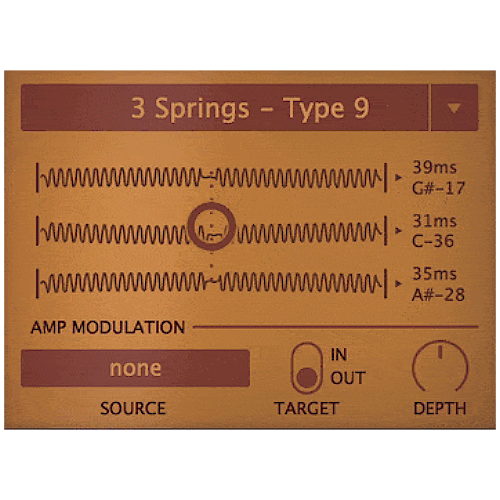
Twangström's reverb is based on physical modelling. As opposed to plug-ins based on impulse responses (IR), our approach mimics the physics of mechanical reverberation. By simulating the wavefront travelling through a medium, we can include all the aspects of excitation, reflection, dispersion, interference, and other audio properties. Twangström does not mimic the sonic result, but simulates the physical device. This means that all dimensions of the device are controllable in realtime, on a per-sample-basis – which all boils down to quite some power at your fingertips!
ENVELOPE
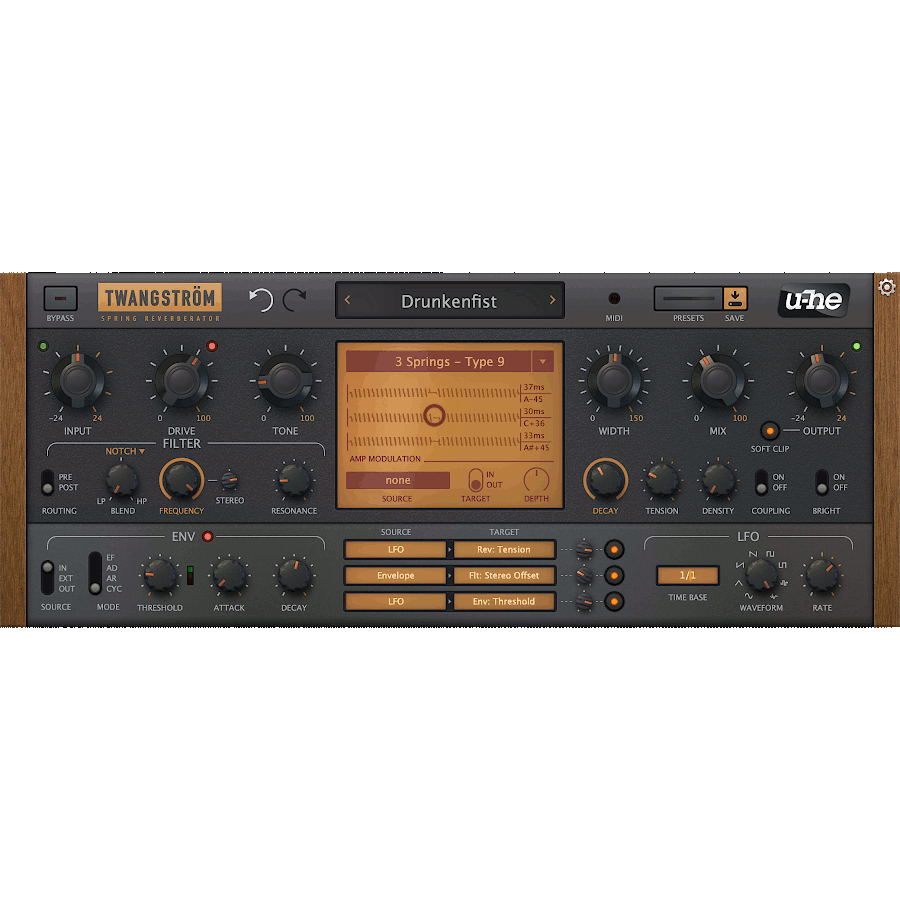
The envelope in Twangström features 4 different modes and can pick up the signal from either input, output or external sidechain. You can select between Envelope Follower, Attack and Decay, Attack and Release, or Cyclic modes. The last one is similar to a 2-stage LFO. Shown controls will adapt to the selected mode, with Threshold not appearing while in Envelope Follower mode.
MODULATION MATRIX
The modulation matrix has three general purpose modulation slots, and yes, you can select shake as one of many targets to modulate the Twang control!
LOW FREQUENCY OSCILLATOR
The LFO features different time bases, including a non-synchronized one measured in seconds. Synchronized options include both dotted times and triplets. There are 8 different waveforms to choose from, with 2 of them being stepped or glide random shapes.