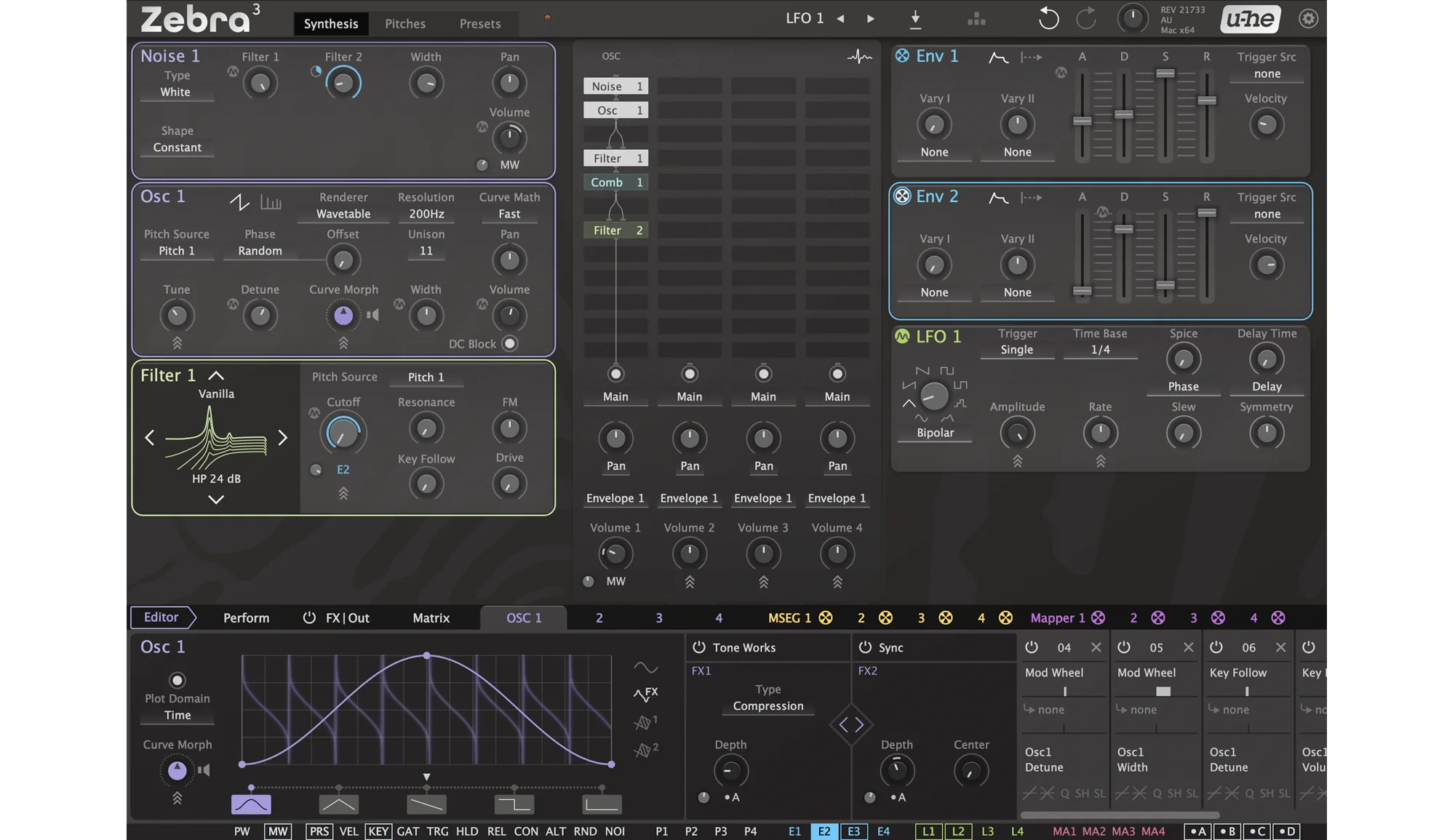
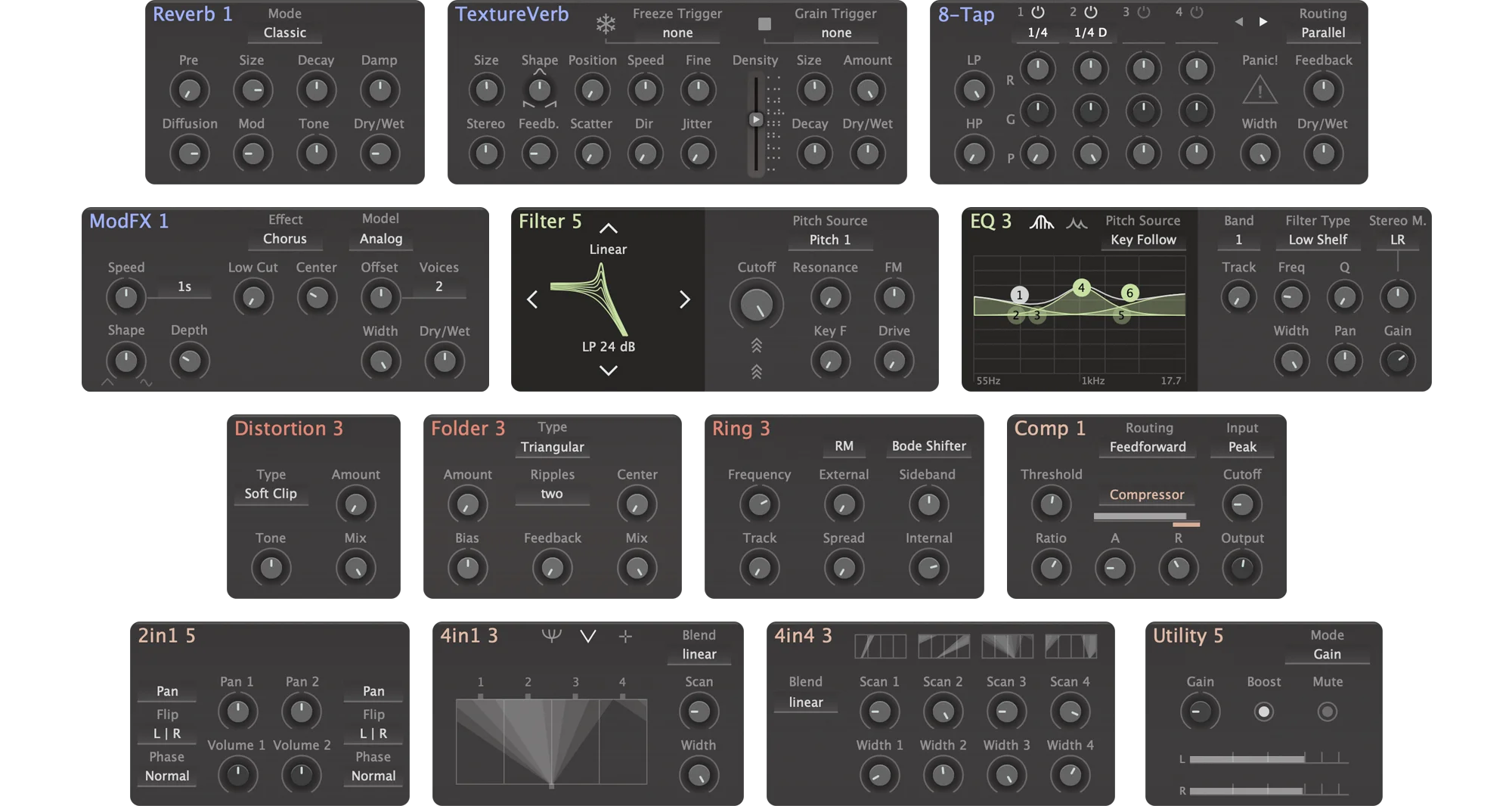
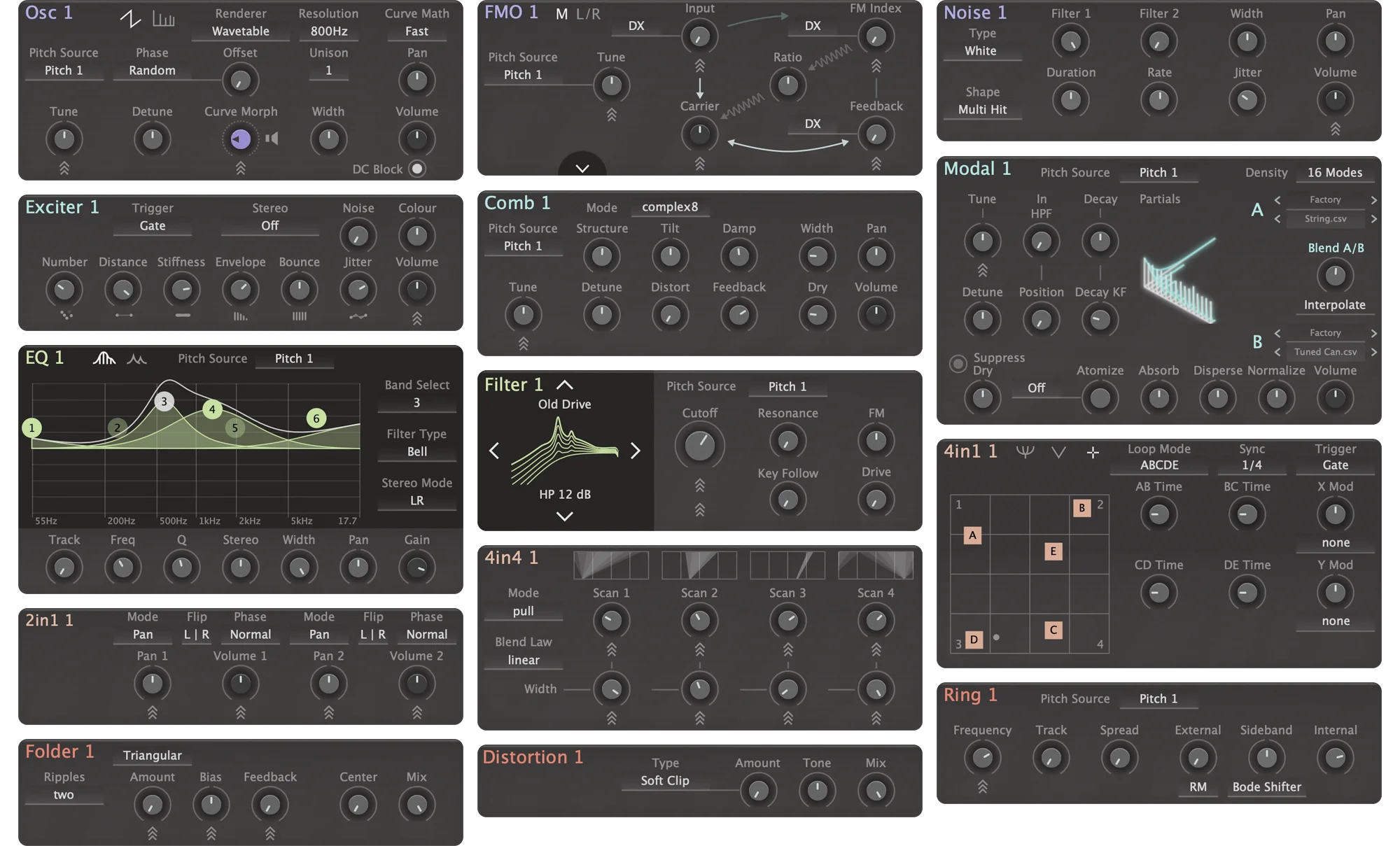
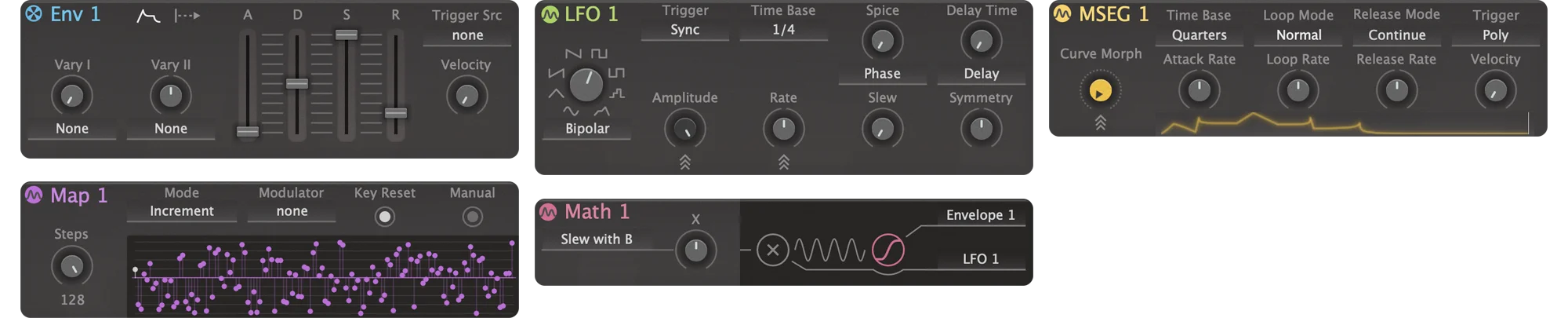
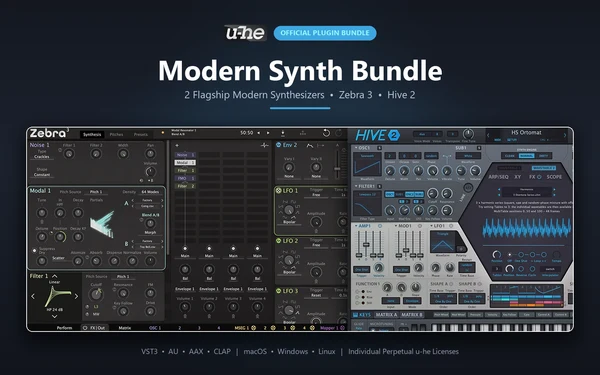
Zebra 3 treats modulation as seriously as sound generation. Four ADSR Envelopes offer velocity sensitivity and a One Shot mode, with two Vary parameters adding options like delay, curvature (self-modulation), stretching or key scaling. Four LFOs cover sine, triangle, saw, square, sample-and-hold and smooth random — with tempo sync, phase offset and a delay ramp for gradual onset. Four MSEGs take things further: up to eight morphable curves along a shared timeline with freely positioned loop points, using the same spline editor as the oscillator. Attack, loop and release macros dynamically scale the speed and amplitude.
Beyond the Rack, on their own page, four dedicated Pitch modules give detailed control over tuning, glide and quantisation, independently managing up to four pitched parts within a single voice. And critically, many modulators double as triggers: an MSEG can drive an Exciter for patterned physical-modelling sequences, bringing rhythmic and melodic structure into the voice itself. In Zebra 3, pitch and gates live on equal footing with regular modulations.
Shaping and combining modulation sources is a particularly interesting area: Four Mappers let you reshape any modulation signal through a custom transfer curve — turning a linear ramp into a logarithmic sweep or a smooth fade into a stepped pattern — and trigger signals can transform a Mapper into a step sequencer. Four Mod Math modules combine, multiply and transform sources before they reach their target, so you can ring-modulate two LFOs against each other or gate randomness with an envelope — all without touching the signal chain.