Sign in to Loot Audio
Access your downloads, purchases and more
Access your downloads, purchases and more

Pulse is a revolutionary new downloader offering blazing fast speeds and powerful control over your libraries. Loot Audio uses Pulse to power some of our downloads and to make managing your libraries more efficient for you.
After your purchase we will send you a unique code (you will also find the code in your account). Use the code with Pulse to power your download and installation. More information about Pulse can be found here.
What are Credits?
You earn Credits every time you purchase a product from Loot Audio. 3% of your order is added to your account in the form of Credits.
Use Credits for money off future orders or convert them to Sample Credits to download samples from the Sounds section of the site.
Time Cube Delay.

$59.00
Earn 159







The Cooper Time Cube was developed in 1971 by Duane H. Cooper and Bill Putnam as an alternative to tape and electronic delay systems. Rather than storing audio electronically, it created delay by sending sound through long coiled tubes, using air as the delay medium. This mechanical approach produced very short delays of approximately 14 ms on one line and 16 ms on the other, or a combined cascade total of around 30 ms. Short enough for doubling and Haas-type effects rather than long echoes. The result was a distinctive echo with acoustic filtering and phase character unlike anything achievable with contemporary tape or BBD designs. With only about 1,000 units ever made, the Time Cube became a rare studio fixture with a strong following for its unique sound. Our emulation is based on an original unit from our collection, in excellent condition, fully serviced and carefully maintained.
While the delay times were fixed and very short compared with contemporary tape echoes or later digital units, the Cooper Time Cube’s acoustic transmission medium and transducer setup gave it a unique frequency response and tonal footprint. In practice this meant its output added a sense of width and presence more than pronounced repeat tails, making it especially useful for doubling, subtle spatial enhancement, and mix placement rather than obvious slapback echoes.
The physical construction contributed to its signature character and helped it earn a dedicated following among engineers despite its limited feature set.
Anyone who has spoken into a long pipe already understands the core idea. The Time Cube works on a principle similar to a spring reverb, but instead of metal springs it uses coils of hose. The signal is sent into the hose by a microphone capsule working in reverse as a tiny speaker, and the sound physically travels through air inside the tube. At the other end, a second capsule picks up the delayed acoustic signal and converts it back to audio.
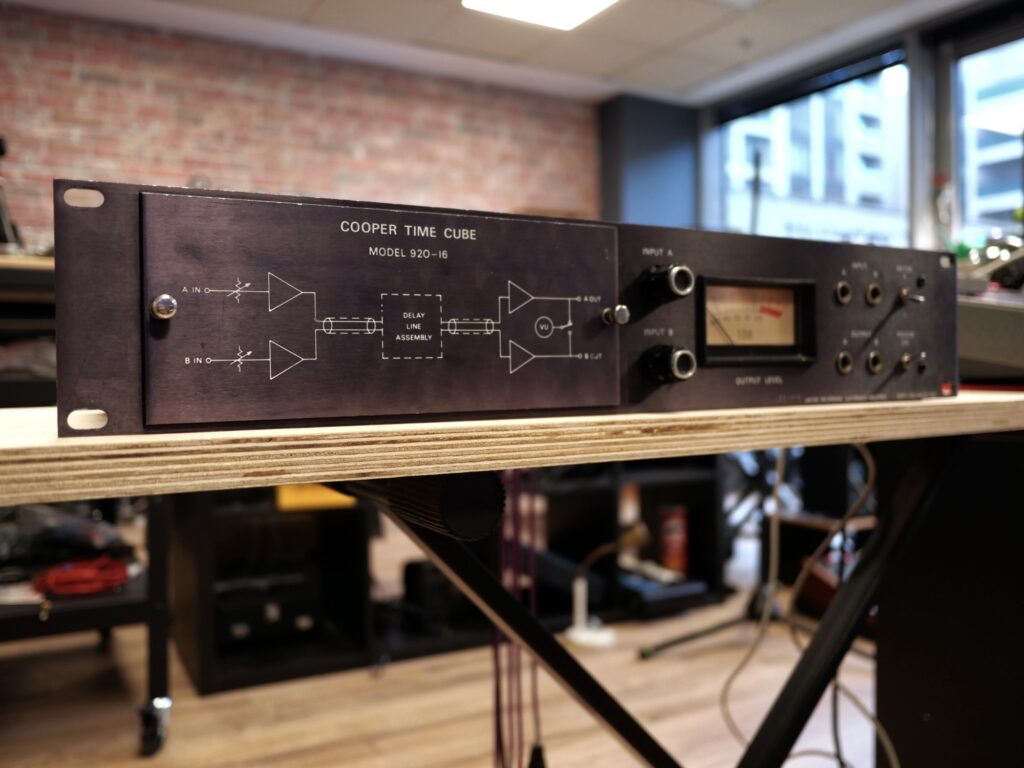
That physical journey through air and tubing is what gives the Time Cube its character. The delay is fixed and very short, but the sound is naturally filtered, slightly uneven, and rich in subtle combing effects that cannot be replicated by conventional electronic delay lines.
To understand the Time Cube properly, we went back to the source and started experimenting with the same physical principle. We built our own acoustic delay paths using garden hose, then moved on to plastic corrugated pipe, testing different lengths, diameters, and materials.
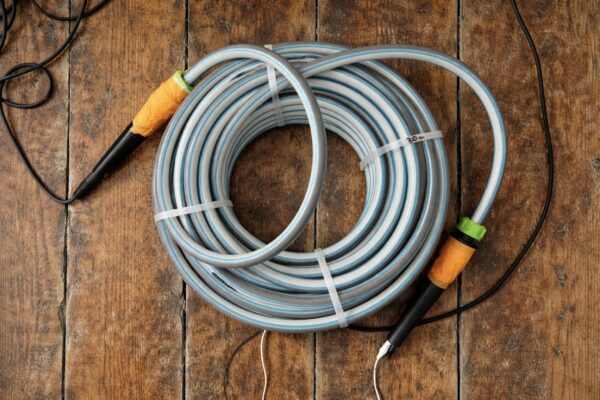
Each variation behaved differently. Garden hose produced a tighter and more focused sound, while corrugated pipe introduced a narrow bandwidth, and a rougher texture. Small changes in the physical path had a clear and sometimes surprising impact on tone, bandwidth, and perceived depth.
This hands on experimentation revealed that the Time Cube concept is far deeper than a single fixed design. There is a whole world of acoustic delay behaviors hidden in simple materials, and our emulation is built on that exploration, extending the original idea while staying true to its unmistakable character.

Of course, meaningfully recreating the Time Cube is not only about modeling air and tubing. The original unit’s preamps and gain staging play a crucial role in shaping its identity, adding subtle saturation, density, and attitude before and after the acoustic delay path. Our emulation captures that entire signal journey, from capsule to tube to output stage, preserving the quirky, imperfect charm that made the hardware so distinctive. The result is not just a short delay, but a compact acoustic space with its own unmistakable voice.
Windows 7 – 11
2GHz CPU, 4 GB RAM
VST2, VST3, AAX, CLAP (64-bit)
macOS 10.13 – macOS 26
2GHz CPU, 4 GB RAM
VST2, VST3, AU, AAX, CLAP (64-bit)
Universal 2 Binary
Ubuntu 20.04 LTS
2GHz CPU, 4 GB RAM
VST2, VST3, CLAP (64-bit)