Sign in to Loot Audio
Access your downloads, purchases and more
Access your downloads, purchases and more

Pulse is a revolutionary new downloader offering blazing fast speeds and powerful control over your libraries. Loot Audio uses Pulse to power some of our downloads and to make managing your libraries more efficient for you.
After your purchase we will send you a unique code (you will also find the code in your account). Use the code with Pulse to power your download and installation. More information about Pulse can be found here.
What are Credits?
You earn Credits every time you purchase a product from Loot Audio. 3% of your order is added to your account in the form of Credits.
Use Credits for money off future orders or convert them to Sample Credits to download samples from the Sounds section of the site.
Echo State Composer.


$62.89
Earn 168







- 12-Layer Polyphonic Generation: Independent rhythm, perforation, and pitch per layer with 5 coordination modes and composite density normalization.
- Echo State Network: Recurrent network reading self-referential musical features and outputting continuous modulation biases. A machine learning layer that evolves the composition from its own output.
- 18 Rhythm Engines: Full implementation of Schillinger's Book I rhythmic vocabulary plus stochastic, Euclidean, L-system, Markov grid, genre-seeded corpus patterns, and a strict subdivision grid for arp-style workflows.
- 12 Pitch Algorithms: Including a harmonic conductor with user-defined chord vocabularies, automatic voice leading, and ESN-driven harmonic transitions.
- MIR Capture System: Real-time MIDI performance analysis. Play a phrase; RESERVOIR absorbs its character and generates from it.
- Genre-Seeded Pattern Wander: An open source corpus of drum patterns processed into genre-specific prototype patterns. The NOMN Drum Computer engine walks these patterns with controllable wander rate.
- Genre Groove Microtiming: Per-genre timing deviations extracted from the drum corpus for stylistically authentic humanization.
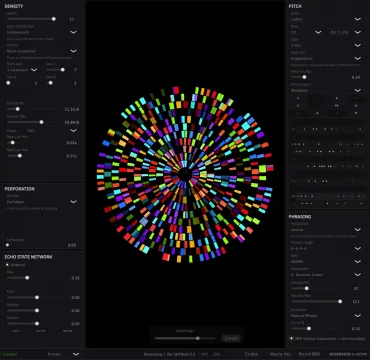
- GPU-Accelerated Visualization: Real-time radial and score display of all layers with 8 color analysis modes rooted in Scriabin, Schillinger, and Rimsky-Korsakov color theory.
- 100+ Scale Library: Western modes, Japanese koto tunings, Indian ragas, synthetic formations, and custom pitch sets.
- In-Plugin Codex: A per-card glossary explaining the math and lineage behind every rhythm, perforation, and pitch engine.
- MIDI Learn: Right-click binding of any parameter to a hardware controller or incoming CC, saved with the project.
- Preset Morphing: Automatable crossfade between any two presets for smooth timbral transitions.
- Audio Gating: Apply perforation patterns to live audio input for rhythmic sculpting of external signals.
- MIDI Export: Multi-track output preserving per-layer polyphonic structure.
- DAW Transport Sync: PPQ-based timing for perfect tempo sync, transport jumps, and loop handling.
Every note passes through four stages:
Generation. 18 rhythm techniques determine when notes occur. The complete first book of Schillinger's rhythmic vocabulary — resultant rhythms, grouping formulas, multi-generator interference, instrumental time rhythms, coordination of duration groups, permutation of durations and rests, homogeneous continuity, distributive powers, growth series, and acceleration curves — alongside stochastic clouds, Euclidean distribution, L-system fractals, harmonic-series pulse streams, Markov-chain beat grids, and genre-seeded pattern wander drawn from an open source corpus of drum patterns.
Perforation. 7 methods determine which notes are removed — where the silences fall, and with what logic. Prime sieves, Fibonacci-based filtering, golden ratio quasiperiodic lattices, cellular automata, modular congruence filtering, Euclidean distribution, and density curves learned from an open source corpus of drum patterns.
Pitch. 12 algorithms determine what notes play, drawing from serial exhaustion, spectral interference, Markov chains, combinatorial permutation, symmetric inversion, corpus-learned transitions, arpeggiator patterns, and a harmonic conductor system with user-defined chord vocabularies and automatic voice leading. Across 100+ scales spanning Western modes, Japanese koto tunings, Indian ragas, synthetic formations, and microtonal systems.
Expression. Velocity shaping, 5 articulation styles, continuous CC controllers across 6 groups (dynamics, timbre, vibrato, articulation, effects, pedal) with phrase-reactive envelopes, and 4 micro-timing modes: metronomic, NOMN expressive timing, user groove profiles captured from live MIDI performance, and genre-specific microtiming extracted from the drum corpus. Not random jitter. Contextual groove that responds to density, phrase position, and stylistic tradition.
12 independent layers, each running its own rhythm generator, perforation filter, and pitch pattern. All streaming, all real-time, all synchronized to DAW transport.
Layers coordinate through 5 interaction modes: full independence, rhythmic inversion (where one layer rests, the next attacks), complementary hocketing (layers fill each other's gaps), synchronized breathing, or monophonic single-voice priority. A composite density model normalizes output across all engine combinations so that switching algorithms preserves perceived density — the texture changes, not the weight. The layer interaction mode transforms the same algorithm settings into dramatically different textures.
An Echo State Network sits above the engine as a meta-generative layer. It reads musical features from RESERVOIR's own output — density, regularity, interval size, pitch range, syncopation, swing, polyphony, contour — and produces slowly drifting modulation biases across pitch, rhythm, and texture dimensions. The reservoir holds temporal echoes of the music's recent past; new modulation emerges from the interference of those decaying traces — the same principle Schillinger described as the interaction of periodicities, now operating at the level of compositional evolution rather than note-level rhythm. A single Evolution Rate knob controls how quickly the network responds. At zero it's nearly frozen; at full it drifts freely, introducing momentum, chromatic pull, timbral shift, and rhythmic tension that emerge from the music itself rather than from random modulation.
A harmonic conductor mode lets you define a vocabulary of chords — up to 32 — and RESERVOIR moves through them with automatic voice leading, driven by ESN tension crossings and quantized to phrase boundaries. A single Drift knob controls how freely the harmony wanders.
A MIR capture system analyzes live MIDI input — extracting pitch contour, rhythmic profile, swing, phrase boundaries, and articulation style — and feeds the resulting performance fingerprint back into the generation engines. Play a phrase in; RESERVOIR absorbs its character and generates from it.
An in-plugin Codex sits behind every card, explaining the math, lineage, and intent of each algorithm in plain language — what Schillinger's grouping formulas actually are, why golden-lattice perforation behaves the way it does, how the Echo State Network reads features back from its own output. The plugin is dense by design; the Codex is the resource that makes the density navigable.
133,000+ unique algorithm combinations before parameter variation or scale selection.
Formats: VST3, Audio Unit (AU).
OS: macOS (Apple Silicon + Intel).