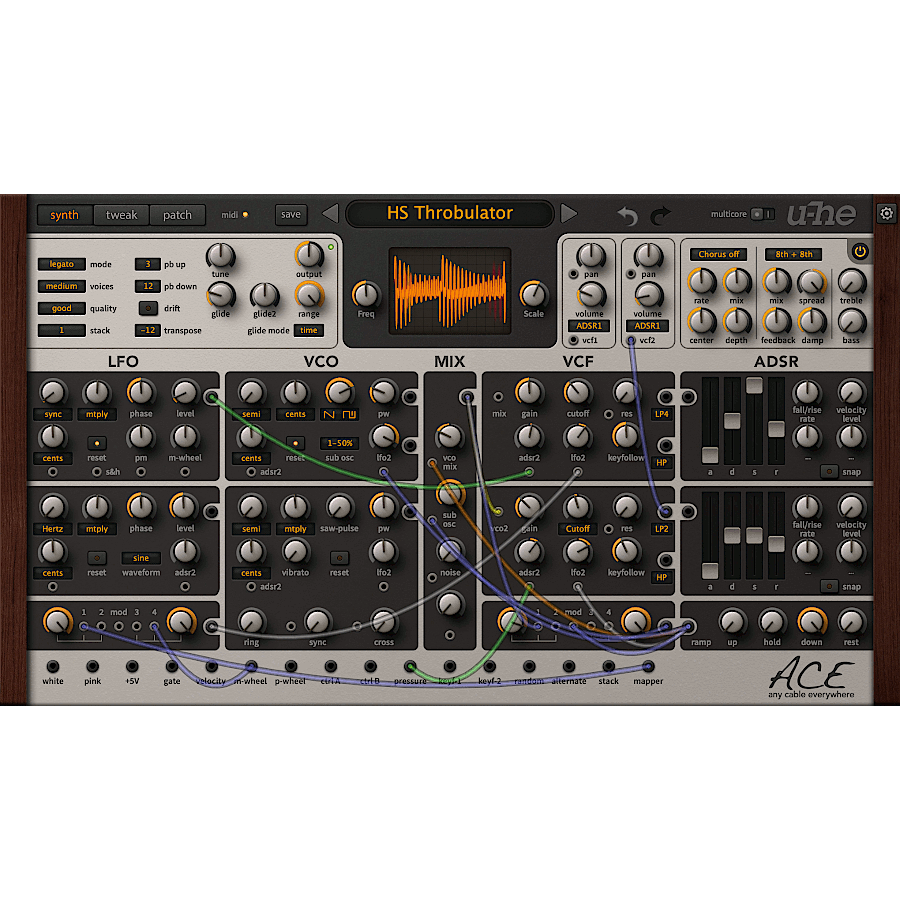
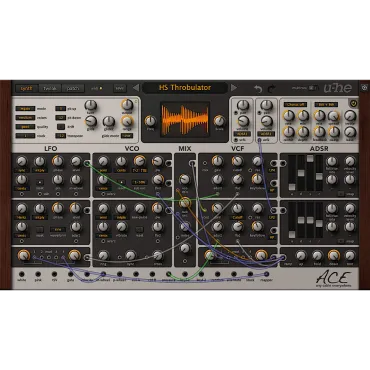
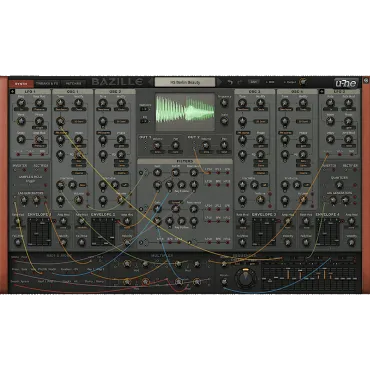
ACE takes after hardware modular synthesizers, although it is not a truly modular design, more correctly it is semi-modular. ACE has a default fixed architecture (like for instance the ARP 2600), which means you can start making noise immediately ‘out-of-the-box’. Any default routing can be overridden by patching cables, which means that the options are practically limitless.
ACE does not differentiate between audio signals and control signals. Any of the outputs can be plugged into any of the signal inputs. Hook things up, explore new ideas and crazy combinations. Try LFOs as audio oscillators or a VCO as LFO. Plug an LFO into a filter, then use the filter as an FM source for an oscillator. Sound experimentation awaits, limited only by your imagination… and dinner time.
Signal sources: An array of output sockets provide signals from a variety of different sources: noise, MIDI controls (modwheel, velocity etc.), mapping generator and more… Use these to add organic life-like dynamics, modulation and refinments your sounds.
Effects: Add final touches using the global effects. Pick from a classic stereo chorus with four modes (including phaser) to add richness, a stereo delay with seven immediately selectable modes to add movement, and finally a pair of controls to boost treble and bass.
Ramp generator: If the two ADSRs and two LFOs are not enough, try the host-syncable Ramp Generator (essentially a trapezoid, which combines elements of both).
Multiples: Common to most modular setups, multiples are mix/split devices. Signals are merged and sent onward, or split and sent to different inputs. In ACE the multiples do act as a simple mixer, or can be enlisted for much more interesting possibilities. That is why we renamed them Multiplex. Using the modulation input and some clever cable arrangements, the Multiplex modules can do ring modulation (RM), amplitude modulation (AM) or both at the same time. Or crossfading or inversion…
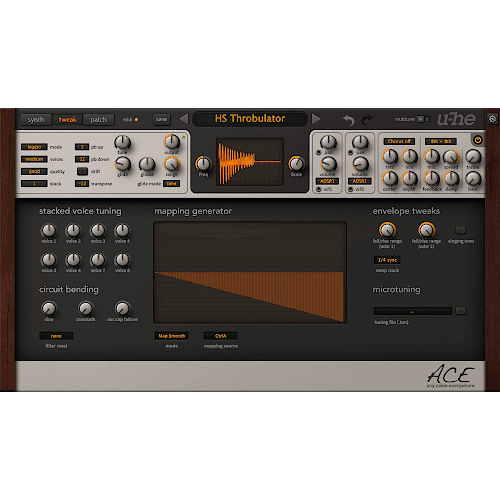
Envelopes: Without envelopes, your patches would just turn on and off with each note, organ style. Envelopes add dynamics over the length of the note. ACE has classic ADSR envelopes, but with a few extras directly available for more interesting results: Snap, fall/rise, level modulation, rate modulation, velocity. The envelopes can be further with modified in the Envelope Tweaks section. Switch on the singing envelopes for classic analogue retriggering behaviour, or adjust the fall/rise limits.