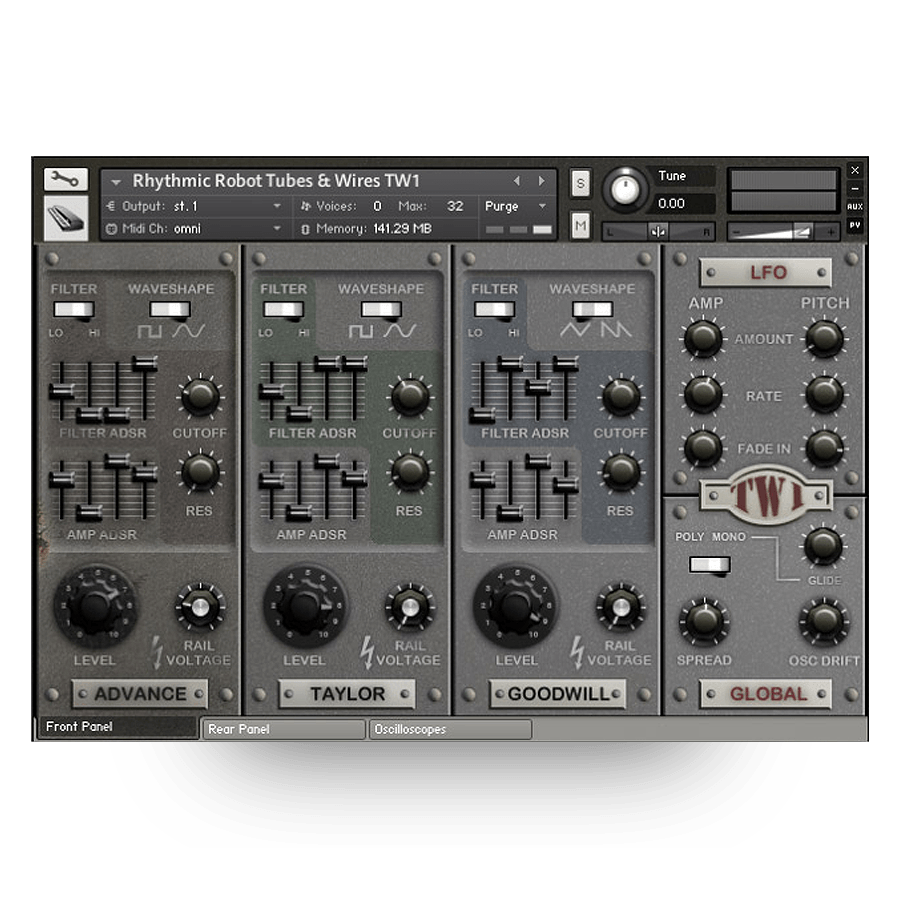
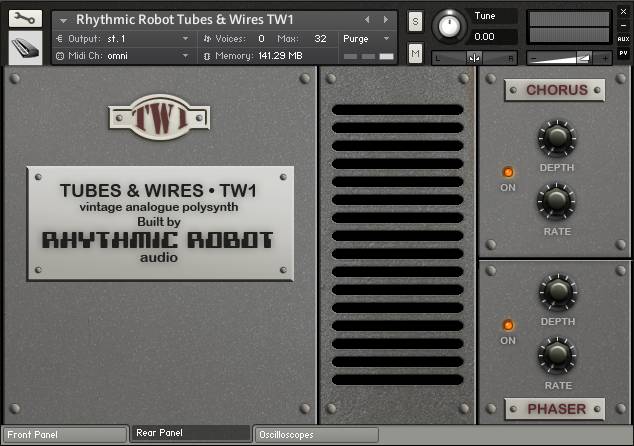
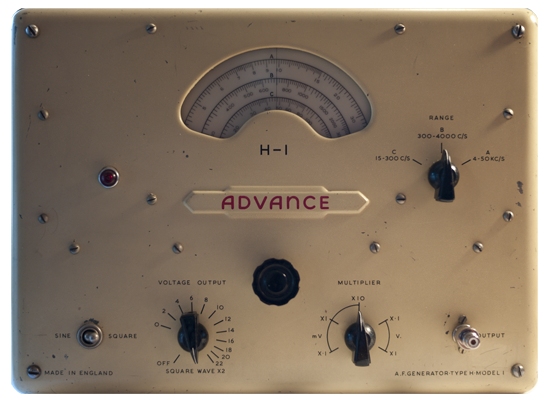
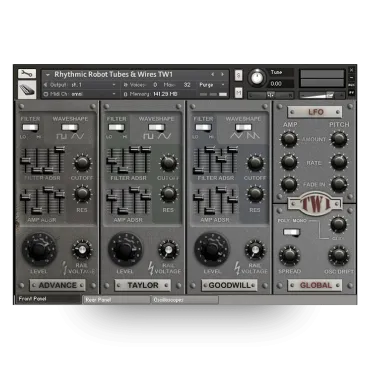
The first oscillator of Tubes & Wires offers both sine and square waves from a rusting old Advance H-1 valve (tube) signal generator. This was by far the most erratic and beaten-up of our selection, and the Kontakt UI reflects this. The sine wave is full of crackles, intermittent noise and glitches from some bad internal connections and a faulty amplifier circuit. It also periodically distorts, flattening the wave slightly. This makes for a wonderfully characterful palette of sound – or you can high-pass filter it until just the crackles and glitches remain, and add these to taste to the other two oscillators to give them a similar kit-on-its-last-legs vibe. It’s quite simply the most un-sine-like sine wave we’ve ever heard. You can see a trace of it to the right.
The Advance square wave setting was, basically, broken. It produced unusable shrieks and cyclical howls. But we found if we lodged the sine / square selection switch at just the right point, we could get a weird, hot, metallic tone from it. It was contaminated with a fair amount of mains overtones and has a very peculiar tonality – almost as if its being ring-modulated. (Who knows. Perhaps it is.) This is what we’ve captured as the Advance “square” wave: a kind of throbbing, warmly dissonant roar that conjures up sci-fi soundscapes and malfunctioning racks of laboratory equipment. Here it is on the left.
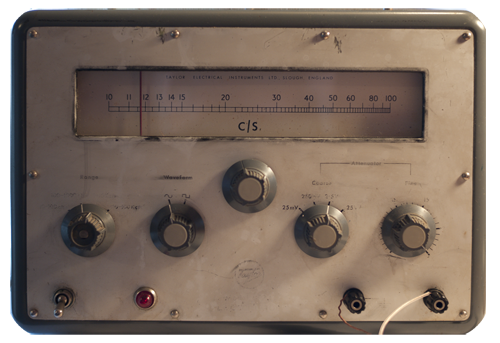
The second oscillator offers a choice of, again, sine and square waves, this time from a Taylor valve (tube) generator. This turned out to have a magical sound quality, as though it had been secretly practicing at being a synth all its laboratory life. Its square wave is a very aggressive, distorted, peaky waveform which is instantly at home being low-pass filtered in classic analogue synth fashion – you can see it to the right here. We found this was our go-to oscillator for a lot of classic patches (and indeed it’s also become the core of Bad Bad Bass).
The sine wave, meanwhile, was being clipped quite badly by its output circuit – which was great! It gives it far more edge than a standard sine – perfect for reinforcing the fundamental frequency of a bass patch, for example. There’s some instability that increases as the wave goes up in pitch, too, so that by its higher ranges it’s starting to look more like a kind of weirded-out square wave.
The third oscillator is taken from a transistor-based Goodwill function generator. We chose this because old valve signal generators generally only offer square and sine waves, and we felt a proper polysynth should have sawtooth and triangle too. Of course, we made sure to choose a Goodwill that was far from perfect. With the duty cycle control of its Ramp waveform turned all the way clockwise we found a good, buzzy sawtooth wave which nevertheless has a lot of slew and inaccuracy in its cycle: sort of a “rose-tinted” sawtooth sound!
Towards the middle of the Ramp generator’s duty cycle we get what’s trying to be a triangle wave, though it’s frankly a bit weird. It looks like it’s been welded together from two different triangle waves in some kind of backstreets chop-shop. But it sounds great. You can of course rough if up still further if you want to by using the oscillator’s “Voltage” control to deliberately overdrive it. (Remember, you have this control available individually for each oscillator – so you can layer up some really steamingly warm patches in no time!)